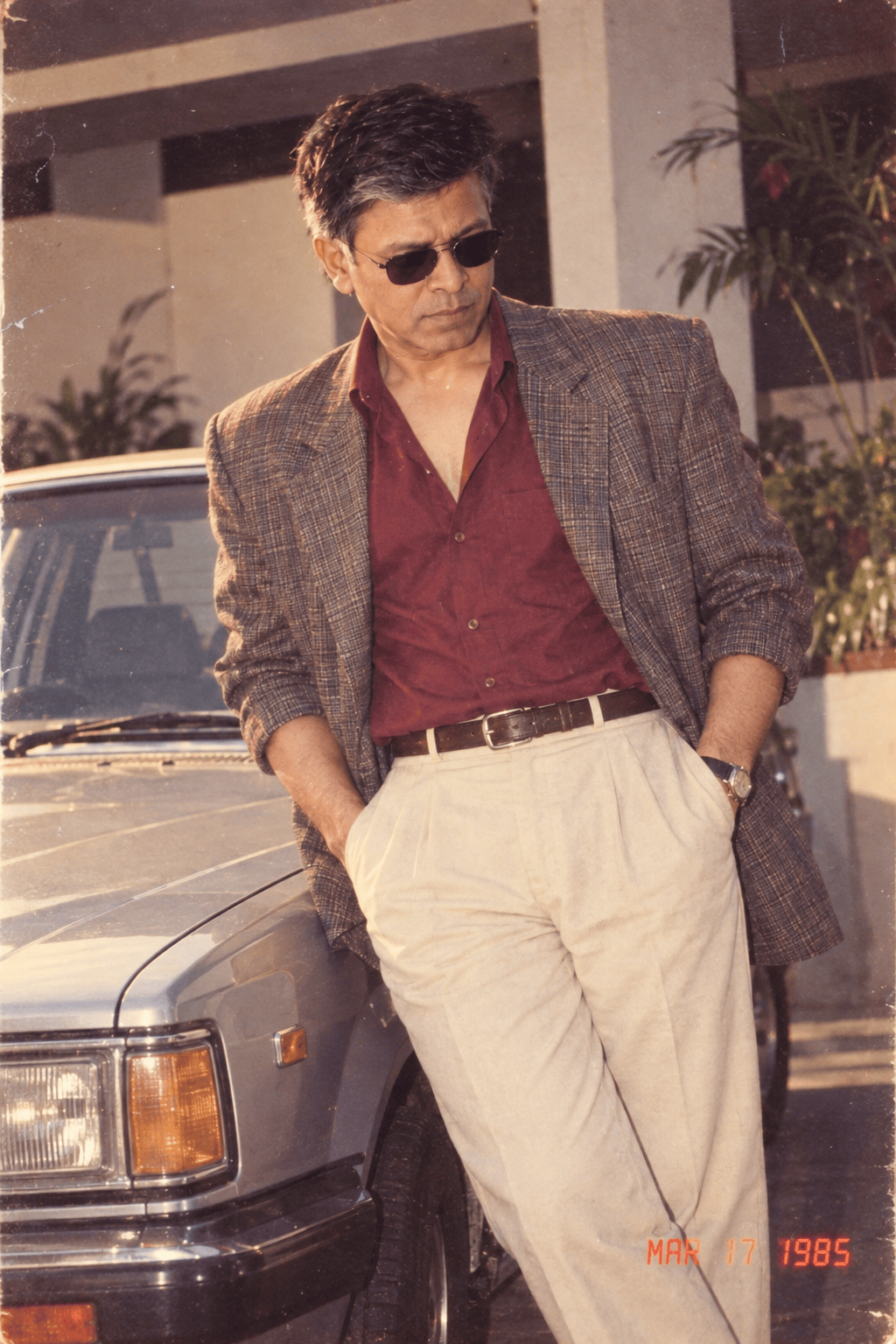
Europe Before Google Maps
A Young Indian Traveller’s Journey Through Europe, 1988–1994
My travels across Europe between 1988 and 1994 belonged to a very different era of travel.
There was no Google Maps, no Internet, no smartphone, no WhatsApp, and certainly no GPS navigation in our pockets. Yet, as a young man in my late twenties and early thirties, I travelled alone through Europe for business, meeting customers and visiting different places.
Looking back today, I feel that travelling in those days required much more planning, confidence and self-reliance than it does now.
Planning the Journey from India
Communication with European customers began with the telephone and fax.
International telephone calls from India were extremely expensive, so every call had to be meaningful. We could not simply call someone whenever we wanted. A conversation was planned, the necessary information was kept ready, and the call was made with the awareness that every minute mattered.
Fax was an important business lifeline.
Customer addresses, appointment confirmations, product information and other business communications could be exchanged through fax. Sometimes I would receive a fax in India and use that information to plan my entire European visit.
There was no online booking system as we know it today.
The telephone directory and business phone book were valuable resources. I would identify potential customers, contact them, make appointments and then arrange my travel route around those appointments.
Today, finding a customer is a matter of a few taps.
In those days, it was part of the adventure.
My Map Was on the Table
Before leaving India, I would spread out a large paper map of Europe on a table.
I would mark the cities I needed to visit and then work out the route.
India → Europe → Customer 1 → Customer 2 → Customer 3 → Hotel → Railway station → Airport…
Everything had to fit together.
Distances had to be estimated from the map. Railway routes and schedules had to be checked. Hotels had to be selected in advance. Appointments had to be arranged carefully because changing plans at the last minute was not as easy as it is today.
There was no blue line on a screen saying:
“Turn left in 200 metres.”
The map simply said where you were.
You had to figure out how to get there.
Travelling Alone
Perhaps the most memorable part was travelling alone.
I was young, somewhere in my late twenties and early thirties, carrying my luggage, documents and business materials, moving from one European city to another.
There was nobody beside me to ask:
“Are we going in the right direction?”
I had to know.
If I arrived at a railway station, I had to understand the local transport system. If I had to reach a hotel, I had to identify it from the address and map. If I missed a train, I had to work out the next possibility myself.
Today, a traveller can immediately use Google Maps, translation apps, online reviews, ride-hailing apps and messaging.
Back then, the traveller himself was the navigation system.
Europe Through Railway Stations
European railway stations became important landmarks in my journeys.
They were not merely places to catch trains. They were points of orientation.
A railway station often gave me access to the next city, information about connections, food and sometimes even a hotel nearby.
I particularly remember staying in a hotel attached to a railway station during my visits to Switzerland. It was convenient after a long journey, and I could get good food there as well.
These small practical experiences became part of the travel memory.
No Online Reviews — Only Experience
There was another major difference.
Today, before booking a hotel or restaurant, we can read hundreds of reviews.
In the late 1980s and early 1990s, there was no such luxury.
You depended on:
– recommendations from business contacts
– travel guides
– telephone directories
– printed maps
– hotel information
– railway information
– your own experience
A good hotel was remembered.
A good restaurant was remembered.
A difficult journey was remembered even more!
Travel reviews were not something we read before travelling.
Our own journey became the review.
The Courage of Being Disconnected
Perhaps the biggest difference between then and now was that I travelled without being continuously connected to India.
Once I left my hotel, I could not simply send a WhatsApp message saying:
«“I have reached.”»
There was no live location sharing.
There was no smartphone camera automatically recording every moment.
There was no Internet search when I suddenly wanted to know something.
For a young traveller, this created a different kind of confidence.
You learned to observe, remember, ask people, read signs, understand maps and solve problems yourself.
Being disconnected was not a disadvantage at that time.
It was simply normal life.
Looking Back from Today
When I look at those European journeys now, I realise that the technology was primitive compared with today’s world, but the experience was in some ways richer.
Today:
Google Maps → route
Online booking → hotel
Internet → information
Smartphone → communication
Translation app → language assistance
Back then:
Map → thinking
Phone book → research
Fax → communication
Railway timetable → planning
Asking people → local knowledge
Memory → navigation
And perhaps most importantly:
Confidence → survival
My European journeys between 1988 and 1994 were therefore not simply business trips.
They were lessons in independence, planning, observation and adapting to unfamiliar places.
I travelled from India to customers across Europe at a time when international travel was far less connected than it is today. I planned my routes on large paper maps, arranged appointments through expensive international telephone calls and fax, travelled alone, navigated railway stations and unfamiliar cities, and returned with experiences that could not be downloaded from the Internet.
Today, I can look at Google Maps and see how much Europe has changed since those journeys.
But the maps I remember most are the ones that were spread across my table in India before I ever started the journey.
Those paper maps did not merely show me Europe.
They helped me discover that I could travel through it on my own.
Three Moments When Europe Tested Me
What travelling without Internet taught me
When I recently shared my memories of travelling alone through Europe during 1988–1994, my daughter had an interesting reaction:
«“Today we can see all the scenic places abroad through reels. Why do we need to travel there?”»
I understood her point. Today, almost every famous European street, mountain, railway station and tourist attraction is available on our phone screen.
But I told her that travel is not only about seeing a place. It is about experiencing what happens when you are actually there.
During my European travels, I had no Internet, Google Maps, smartphone, digital wallet or instant communication.
And on three occasions, I faced situations that I still remember vividly.
1. I Left My Passport and Money at a Railway Station
One day, after travelling through a railway station, I suddenly realised that I had left my purse containing my passport and money behind.
Today, the first reaction might be:
“Call someone.”
“Check Google Maps.”
“Block the cards.”
“Send a WhatsApp message.”
But none of those options existed for me.
I had to turn around and go back to the railway station.
The thought of losing my passport in a foreign country was frightening. The passport was much more important than the money.
When I reached the place where I thought I had left it, the purse was still there.
Untouched.
Passport and money were safe.
I cannot forget that moment.
It was not merely relief.
It was also a memorable lesson about trust and honesty.
2. Money Exhausted — London to Paris
Another incident was even more unusual.
During one European trip, I found myself with very little money left.
I still had to travel from London to Paris.
Today, if someone’s money is exhausted, there are numerous possibilities—online banking, digital transfers, cards, mobile payments and instant communication.
I had none of these.
Yet the journey somehow worked out through human connections and help from people.
I met a friend, explained my situation, and through that connection and assistance from the airline authorities, I was able to travel from London to Paris without paying for the journey myself.
What I remember most is not the free trip.
It is the fact that, without Internet or digital money, people themselves became the network.
A friend, a conversation, a little trust and some human cooperation solved a problem that technology would solve automatically today.
3. The Visiting Card Pouch I Left Behind
The third incident was perhaps the most interesting.
I had left my visiting-card pouch in a hotel.
Normally, this might seem like a small problem.
But that pouch contained something extremely important for my business travel:
customer addresses and telephone numbers.
I had no smartphone.
I had no Google Contacts.
I had no email search.
I could not simply open an app and find the customer’s address.
I could not even easily call a taxi because I did not have the customer’s address or telephone number with me.
For a moment, I was effectively disconnected from my own business network.
So what did I do?
I relied on my memory.
I remembered the route.
I remembered the surroundings.
I started walking.
Step by step, I reconstructed the journey in my mind and eventually found my way to the customer.
That was a completely different kind of navigation.
Google Maps was inside my head.
And when I finally reached the destination, the satisfaction was enormous.
What My Daughter’s Reels Cannot Show
This is why I told my daughter:
A reel can show you the Eiffel Tower.
It can show you the Swiss Alps.
It can show you a beautiful European railway station.
It can show you London, Paris or Zurich in perfect 4K.
But a reel cannot give you the feeling of standing in a foreign railway station after discovering that your passport and money are missing.
It cannot give you the relief of finding them untouched.
It cannot reproduce the uncertainty of having no money and then finding a human solution to continue your journey.
And it cannot give you the satisfaction of walking through an unfamiliar city using nothing but your memory and observation, finally reaching the customer you were trying to find.
That is the difference between seeing a place and travelling through it.
Today, technology makes travel easier.
In my generation, travel made us resourceful.
We carried paper maps instead of Google Maps.
We carried visiting cards instead of digital contacts.
We carried cash instead of digital wallets.
We asked people instead of asking search engines.
And when something went wrong, we had to solve it ourselves.
Perhaps that is why, even after so many years, I remember those European journeys so vividly.
The scenery was beautiful.
But the real adventure was not knowing exactly what would happen next.
2. From London to Paris — A Ten-Year-Old Friendship Reappeared
Another unforgettable incident happened in London.
At that time, I had exhausted my money and had to continue my journey to Paris. In the days before Internet banking, smartphones and digital payments, that could have been a serious problem.
Then something almost unbelievable happened.
I entered a lift in London.
As the lift was moving, I happened to meet a person whom I had known in India about ten years earlier.
We had not planned to meet.
We had not communicated online.
We had no mobile phones to locate each other.
We simply happened to meet in the middle of a lift in London.
That chance meeting became the turning point.
There was also an unused stopover facility associated with my travel arrangement. Since I had not used that facility, the London-to-Paris sector could be arranged without an additional fare.
So, despite having exhausted my money, I was able to continue from London to Paris completely free of charge.
Looking back, the remarkable part is not merely that I travelled from London to Paris without paying.
It was the chain of coincidences:
Money exhausted → unexpected lift encounter → friend from India after 10 years → unused stopover facility → London to Paris.
Today, we can locate a person instantly, transfer money digitally and book another ticket within minutes.
But in those days, there was no Internet to rescue us.
Sometimes, life itself provided the connection.
That is one reason my European journeys remain so vivid in my memory. Some experiences could never have been planned into an itinerary—and certainly could never have been experienced through a reel.

